
As of April 2025, a staggering 122 million people worldwide have been forcibly displaced due to persecution, conflict, and violence (via UN Refugees). This underscores the urgent and complex nature of humanitarian migration, a global issue that demands our attention.
For anyone seeking safety or urgent entry into the U.S., understanding the difference between humanitarian parole and refugee status is not just crucial, but empowering. Choosing the right pathway can determine whether you gain temporary access, long-term protection, work authorization, or a path to permanent residency. So, if this has been on your mind or if it is something you want to know more about, keep reading, because I’m about to unveil a whole lot of information for your benefit.
What Is Humanitarian Parole?

Humanitarian parole is a case-by-case, temporary permission for someone outside the U.S. to enter, or for someone inside the U.S. to remain, for urgent humanitarian reasons or significant public benefit; it’s discretionary and time-limited.
Humanitarian parole allows the U.S. government to admit individuals who otherwise lack a visa when there is an urgent need—examples include life-saving medical treatment, family reunification in emergencies, or other significant public-benefit reasons. Parole is not an admission or a grant of immigration status; it’s an exception to standard admissibility rules that agencies can grant and later revoke.
What Is Refugee Status?

Refugee status, on the other hand, is a protection given to people overseas who meet the refugee definition and are admitted to the U.S. through refugee resettlement; it includes immediate work authorization and a required green-card filing after one year.
Refugees are determined eligible abroad—often through UNHCR referral or other resettlement channels—and then admitted under USRAP. Once admitted as a refugee, the individual has legal protections, access to resettlement services, and permission to work incident to status. Refugees are required to apply for adjustment to lawful permanent resident status after one year in the U.S. USCIS provides a fee waiver for that adjustment filing for refugees. Resettlement benefits (cash and medical assistance) are administered by the Office of Refugee Resettlement (ORR), though eligibility periods and program details can change.
Humanitarian Parole vs Refugee Status — Core Differences Explained

Humanitarian parole is a temporary, discretionary permission to enter or stay in the U.S. for an urgent need and doesn’t by itself create immigration status or a direct path to a green card.
Refugee status is a formal protection granted abroad through the U.S. Refugee Admissions Program (USRAP) that does include work rights, resettlement support, and a required step to apply for a green card after one year.
Here is a table below that explains it well:
| Feature | Humanitarian Parole | Refugee Status |
|---|---|---|
| What it is | Short-term permission to enter/stay without “admission” or status. | Protection status granted before U.S. entry via USRAP. |
| How you apply | Case-by-case request for urgent humanitarian reasons/public benefit. | Referred/vetted abroad (often via UNHCR/Resettlement Support Centers). |
| Who decides | DHS/USCIS (or CBP in limited circumstances) at discretion. | USCIS & State Dept. through the refugee program. |
| Duration | Time-limited (often up to 1–2 years), can end or be re-paroled. | Ongoing status in the U.S.; must apply for LPR after 1 year. |
| Work rights | Not automatic—most parolees file for an EAD. | Authorized to work incident to status upon arrival. |
| Benefits | Limited by default; some groups may be made eligible by special policy. | Eligible for refugee resettlement services (time-limited). |
| Green card path | No direct path—needs a separate basis (asylum, family, employment). | Yes, you must apply after one year in the U.S. |
| Travel | Leaving the U.S. can end parole; travel is risky without advice. | Travel is possible with the correct documents after adjustment. |
Humanitarian Parole vs Asylum vs Refugee Status—How They Compare
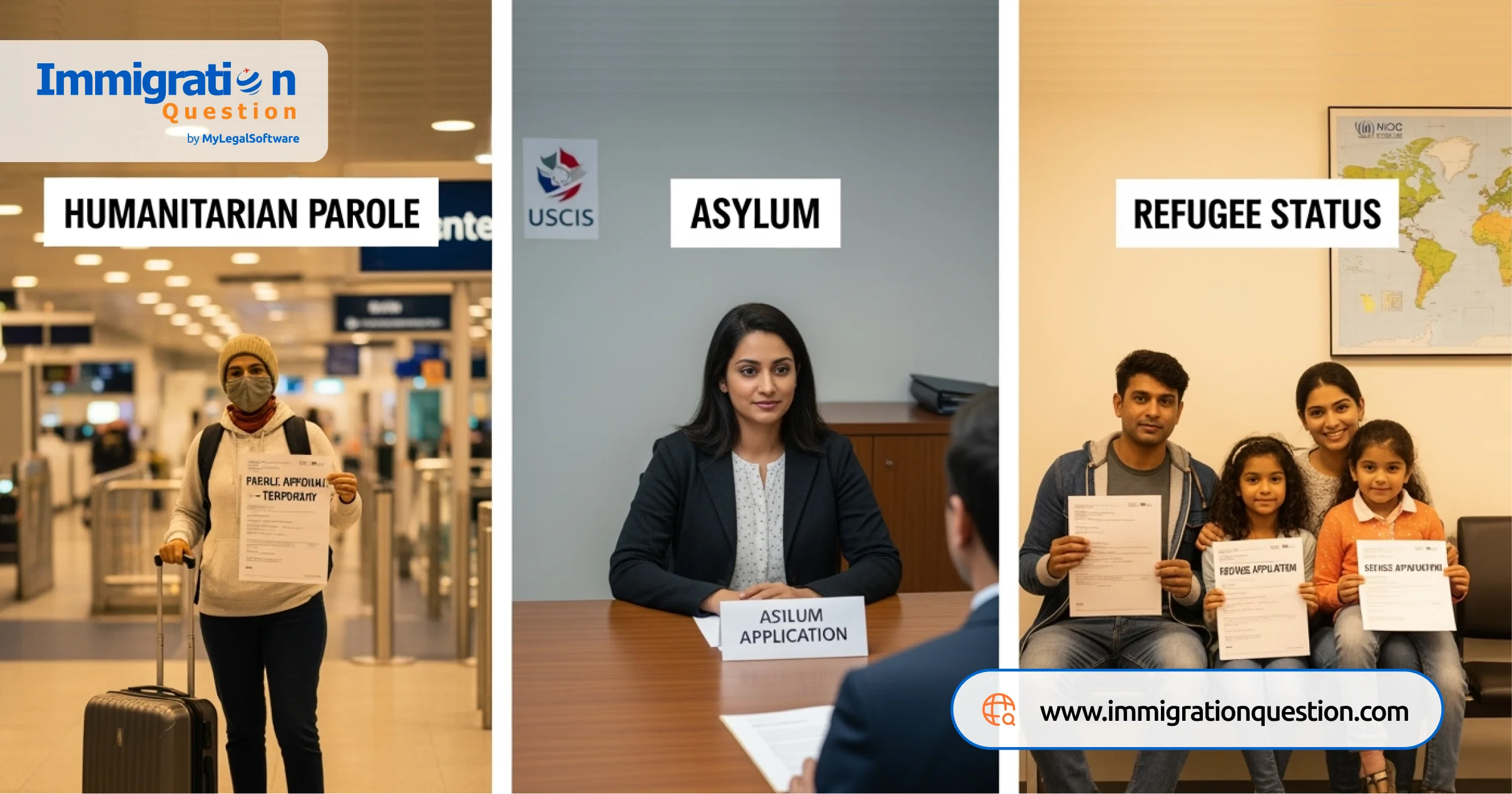
Another important term that stands side by side with humanitarian parole and refugee status is asylum, and their differences need to be spelled out.
Now, what is this asylum, and how is it different from humanitarian parole and refugee status?
Asylum and refugee status use the same legal definition of “refugee,” but asylum is claimed inside the U.S. (or at a port of entry) while refugee status is granted abroad; both can lead to permanent residence, unlike parole.
Asylum seekers are physically present in the U.S. or at a port of entry and submit Form I-589 to request protection. If granted asylum, an asylee has similar long-term protections as a refugee and can apply to adjust status to LPR after one year.
Parole is different: it’s a temporary entry route and doesn’t by itself create the protections or durable legal standing that asylum does. Importantly, people who enter with parole can still apply for asylum from within the U.S., but the nature and timing of their claims and the categories of work authorization they use may differ.
Below is a table that clearly states the differences:
| Feature | Humanitarian Parole | Asylum | Refugee Status |
|---|---|---|---|
| Where You Apply | From outside the U.S. (or in rare cases, inside for urgent humanitarian reasons). | Inside the U.S. or at a U.S. port of entry. | From outside the U.S., through the refugee resettlement process. |
| Purpose | Temporary entry for urgent humanitarian reasons or significant public benefit. | Protection from persecution for people already in the U.S.. | Protection from persecution before entering the U.S. |
| Application Form | Form I-131 (Application for Travel Document). | Form I-589 (Application for Asylum and for Withholding of Removal). | Determined by the U.S. Refugee Admissions Program (no self-submitted USCIS form). |
| Legal Standing | Temporary — does not provide a direct path to permanent residence. | Can lead to a green card (after 1 year) if granted. | Can lead to a green card (after 1 year) if granted. |
| Work Authorization | Must apply separately for work authorization (Form I-765). | Eligible for work authorization while the case is pending or after approval. | Eligible for work authorization upon arrival in the U.S. |
| Length of Stay | Temporary (length decided by USCIS, often 1–2 years). | Indefinite as long as protection is needed and status is maintained. | Indefinite as long as protection is needed and status is maintained. |
| Key Difference | Temporary entry route; no built-in protection from persecution. | Claimed in the U.S.; protection against persecution with a path to LPR. | Granted abroad; protection against persecution with a path to LPR. |
Which Path Is Right for You — Humanitarian Parole, Refugee, or Asylum?

Choosing between humanitarian parole, refugee status, or asylum can feel confusing — but understanding the key differences can save you time, money, and stress. The right path depends largely on where you are, your circumstances, and the urgency of your situation.
If you are outside the U.S. and meet the definition of a refugee — meaning you face persecution based on race, religion, nationality, political opinion, or membership in a particular social group — refugee status may be your best route, especially if you can access resettlement programs through UNHCR or USRAP.
If you are already inside the U.S. and fear returning to your home country for the same protected reasons, asylum could be your option. It offers a pathway to stay in the U.S. long-term and eventually apply for a green card.
Humanitarian parole, on the other hand, is a temporary solution for urgent entry when no other visa or pathway is available in time. It can be a lifeline for emergencies — such as urgent medical treatment or escaping immediate danger — but it is not permanent. You’ll need to plan for a follow-up immigration status and may require a sponsor.
Before making a decision, think about your location, eligibility, urgency, and long-term goals. And because a small detail can change your entire case, consulting an experienced immigration attorney is highly recommended.
Key 2025 Policy Updates Impacting Parole vs Asylum vs Refugee Planning

If you’re planning to apply for humanitarian parole, asylum, or refugee status in 2025, there are a few major policy shifts you need to know about—because they could change your strategy entirely.
First, on January 28, 2025, USCIS hit the pause button on all new I-134A supporter filings. This is part of a review of certain categorical parole processes under a recent Executive Order. In simple terms, if you were planning to have a U.S.-based supporter file an I-134A for you, you’ll need to hold off until further notice. Always check the most up-to-date USCIS guidance before moving forward.
Then, on May 5, 2025, the Office of Refugee Resettlement (ORR) made a big change that affects financial and medical assistance for new arrivals. Refugee Cash Assistance (RCA) and Refugee Medical Assistance (RMA) now last just 4 months instead of the previous 12. That’s a steep drop, so it’s more important than ever to plan ahead, explore community resources early, and line up additional support.
Finally, keep in mind that as per Refugees International, several major categorical parole programs—like CHNV (Cuba, Haiti, Nicaragua, Venezuela) and Uniting for Ukraine—are facing legal challenges and policy adjustments. These shifts could impact timelines, eligibility, or benefits, so double-check the current rules before you apply.
The bottom line is that a lot is shifting quickly, and staying informed could mean the difference between a smooth process and a frustrating delay.
Clarify Your Immigration Options Today

If you still have questions about humanitarian parole, refugee status, or asylum, and you want verified; up-to-date information tailored to your situation—don’t guess.
Visit ImmigrationQuestion.com to ask your questions for free and get direct answers from registered immigration attorneys, often within hours. It’s a smart way to get clarity, protect your options, and move forward with confidence. Don’t keep waiting, ask your questions on ImmigrationQuestion.com today.
FAQs: Humanitarian Parole vs Refugee vs Asylum
1. Is humanitarian parole the same as refugee status?
No. Humanitarian parole is temporary permission to enter/stay for urgent reasons; refugee status is a formal protection granted abroad with a required step to apply for a green card after one year.
2. Can I apply for asylum while on humanitarian parole?
Yes. If you’re in the U.S. and fear persecution, you can file Form I-589 for asylum—generally within one year of your most recent arrival.
3. Does humanitarian parole lead to a green card?
Not by itself. Parole doesn’t create immigration status. You’d need a separate basis (family, employment, asylum, or special legislation) to adjust status.
4. Are parolees work-authorized automatically?
No. Most parolees must apply for an EAD with Form I-765 (typically category (c)(11)). Refugees and asylees are work-authorized incident to status.
5. Humanitarian parole vs asylum—what’s faster?
It depends. Parole can be faster for urgent entry, but it’s temporary. Asylum timelines vary by office and court backlogs; asylum is a durable protection if granted.
6. Can I travel internationally on humanitarian parole?
Travel is risky. Leaving the U.S. can end your parole. Speak to an attorney before any trip and confirm what documents you’d need to re-enter.
7. What happens when my parole expires?
If you don’t have another status or apply for parole again, you may fall out of lawful presence. Apply for a longer-term option (e.g., asylum, family-based, employment-based) as early as you’re eligible.