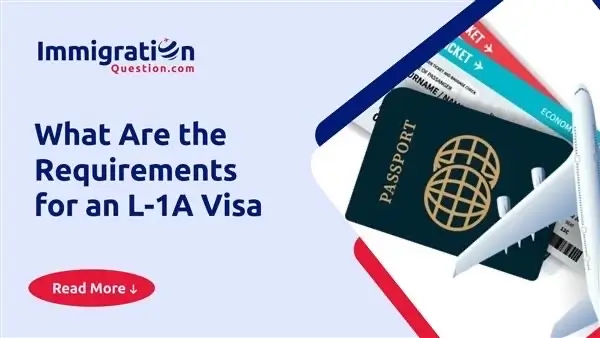
The L-1A visa allows multinational companies to transfer executives and managers from a foreign office to a related entity in the United States. Companies use it to place senior personnel in U.S. operations, ensuring continuity and leadership across borders.
Eligibility depends on both the relationship between the foreign and U.S. entities and the employee’s role, which means that both employer and employee must meet specific requirements before the petition can be approved.
The L-1 Visa Framework
The L-1 visa category applies to intracompany transferees moving from a foreign entity to a U.S. entity that shares ownership or control. Within the category, there are two classifications: L-1A for executives and managers, and L-1B for employees with specialized knowledge. The L-1A visa focuses exclusively on senior-level roles.
It requires evidence that the employee manages people, functions, or the organization itself, rather than performing operational tasks. The classification ensures that key personnel are available to lead U.S. operations in line with corporate strategy.
Definition of the L-1A Visa
A foreign national qualifies for the L-1A visa if they have worked abroad in an executive or managerial capacity and will continue in a similar role in the United States. USCIS evaluates the actual duties performed, looking at the level of responsibility, oversight, and decision-making authority.
The employee must demonstrate that they exercised significant authority abroad and will perform comparable duties in the U.S., establishing continuity between the foreign and U.S. positions.
Employment History Requirements
To meet the visa criteria, the employee must have been employed abroad for at least one continuous year within the three years preceding the filing of the petition. This employment must have been with a foreign entity that maintains a qualifying corporate relationship with the U.S. petitioner, such as a parent company, subsidiary, affiliate, or branch.
The role abroad must have been executive or managerial, and the applicant must provide evidence of their authority, supervisory responsibilities, and scope of operations. USCIS looks for a consistent record showing that the employee performed high-level management functions, rather than day-to-day operational tasks.
Executive Capacity
An employee qualifies as an executive if they direct the management of the organization or a major component of it and make decisions with broad discretion. Executives establish policies, set goals, and act with limited oversight from higher-level leadership.
USCIS examines whether the employee focuses on strategy rather than routine operations, reviewing evidence such as organizational charts, reporting lines, and examples of decision-making authority to confirm that the role is truly executive.
Managerial Capacity
An employee qualifies as a manager if they oversee the work of professional staff, supervise other managers, or control an essential function or department. Some managers may not have direct reports but can qualify if they exercise discretion over operations critical to the business.
In evaluating managerial capacity, USCIS considers whether the employee’s responsibilities are primarily managerial rather than operational and whether the function they oversee is essential to the organization. Authority over personnel, budgets, and operational decisions demonstrates the managerial role required for the L-1A visa.
Requirements for the U.S. Employer
The U.S. employer must maintain a qualifying relationship with the foreign entity at the time of filing and throughout the employee’s stay. Both entities must be actively conducting business, since passive ownership does not meet the standard.
The U.S. position offered must align with the employee’s prior role abroad, reflecting similar executive or managerial responsibilities. Petitions typically include corporate ownership records, organizational charts, payroll documentation, and detailed job descriptions to show that the employee’s duties abroad and in the U.S. are consistent.
L-1A Petitions for New U.S. Offices
The L-1A visa can also be used to establish a new office in the United States, but these petitions require additional evidence. The employer must secure a physical office before filing, as virtual offices generally do not meet requirements.
The employee must satisfy the one-year foreign employment requirement in an executive or managerial role, and the U.S. entity must demonstrate the ability to support the position within one year.
USCIS typically requires a business plan with staffing projections, financial data, and operational goals to show that the U.S. office will function as a viable business. Initial approvals for new office petitions are limited to one year.
Period of Stay and Extensions
For existing offices, the L-1A visa may be approved for up to three years, with extensions granted in two-year increments. New office approvals are limited to one year, and extensions require evidence that the business has grown and can sustain the executive or managerial position.
The maximum stay under L-1A status is seven years. During this time, employees can continue to manage operations, supervise staff, and oversee corporate strategy in alignment with the objectives of both the U.S. and foreign entities.
Start your L-1A visa process with professional support at ImmigrationQuestion.com.
Frequently Asked Questions
- What are the main requirements to qualify for an L‑1A visa?
To qualify, the employee must have worked for a qualifying foreign company in an executive or managerial role for at least one continuous year within the past three years and the U.S. employer must have a qualifying relationship with that foreign company. The U.S. job must also be in an executive or managerial capacity.
- What counts as an executive or managerial role for an L‑1A visa?
An executive role involves directing major components of an organization and making broad decisions, while a managerial role includes supervising professional staff or managing essential business functions.
- Can my family come with me if I get an L‑1A visa?
Yes. Spouses and unmarried children under 21 may accompany you under L‑2 status, and spouses may apply for work authorization.
- How long can I stay on an L‑1A visa?
The initial stay is up to three years for established offices, and you can request extensions in two‑year increments. The maximum stay in L‑1A status is seven years.
- Do both the U.S. and foreign companieshave tobe actively doing business?
Yes. Both the foreign and U.S. entities must be actively conducting business (not just passive ownership) and maintain a qualifying relationship such as parent, affiliate, subsidiary, or branch.