
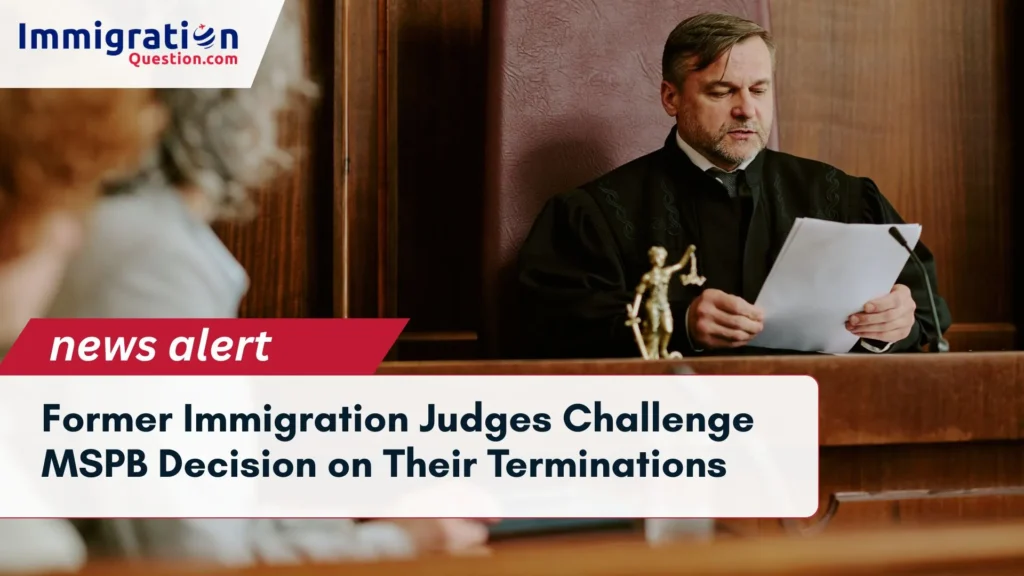
A new legal challenge is underway as two former immigration judges contest a ruling that could significantly expand presidential authority over federal employees. The dispute comes alongside a broader tightening of U.S. immigration policies, including an expanded visa bond program targeting foreign travelers.
The case follows a decision by the Merit System Protection Board (MSPB), which held that the president has constitutional authority under Article II to remove immigration judges without cause. The ruling effectively places these judges outside traditional civil service protections, classifying them as “inferior officers.”
Appeal Filed in Federal Circuit
The appellants, Megan Jackler and Brandon Jaroch, were terminated in February 2025 and are now appealing to the U.S. Court of Appeals for the Federal Circuit. Represented by the Washington Litigation Group, they argue the firings violated the Civil Service Reform Act , which guarantees due process and pre-termination rights to federal employees.
Their attorneys say the MSPB’s decision contradicts long-standing legal precedent and could weaken protections for the broader federal workforce. Critics warn that the ruling may open the door to politically motivated dismissals, raising concerns about a shift away from merit-based employment.
Government Defense and Wider Impact
The U.S. Department of Justice has defended the terminations, maintaining that immigration judges fall under presidential removal authority. Officials expressed confidence that the decision will hold up under further judicial review.
Observers say the implications extend beyond immigration courts. Former MSPB member Raymond Limon described the decision as unprecedented, noting that it removes long-standing appeal rights for certain federal employees. The ruling aligns with broader efforts to reshape federal personnel policies.
Visa Bond Expansion Raises Concerns
At the same time, the administration is expanding a visa bond program requiring certain travelers to pay up to $15,000 as a condition of entry. The policy now applies to applicants from 50 countries and primarily affects B1 and B2 visa categories used for business and tourism.
Officials say the bond is refundable if travelers comply with visa terms, including timely departure. The measure is intended to reduce visa overstays by introducing a financial incentive for compliance. However, critics argue it could create barriers for legitimate travelers, particularly those from lower-income countries.
Looking Ahead
Both developments reflect a broader shift in U.S. immigration and administrative policy. As legal challenges move forward and implementation begins, the outcomes could reshape federal employment protections and immigration enforcement strategies.
For more updates on immigration law, policy changes, and enforcement trends, visit ImmigrationQuestion.com.
Post your questions for free and get answers from licensed immigration attorneys.
Download the free ImmigrationQuestion.com app on Google Play Store and the Apple App Store.
Sources:
- https://share.google/GDg7QP5oiNSYNg32z
- https://share.google/AEce5Nxs6i8aWz7xw
- https://share.google/J0qpRMgMJqZLGRxTQ
- https://share.google/QRDjbrMeLZBb1Gs0k
ImmigrationQuestion.com is a networking platform founded by Immigration Attorneys. It serves as a meeting ground for licensed immigration attorneys and people with immigration questions. It is not a law firm. It is not affiliated with or endorsed by USCIS or AILA. Attorneys on this platform are independent and have the discretion to offer a free consultation and/or set their fees under the law.