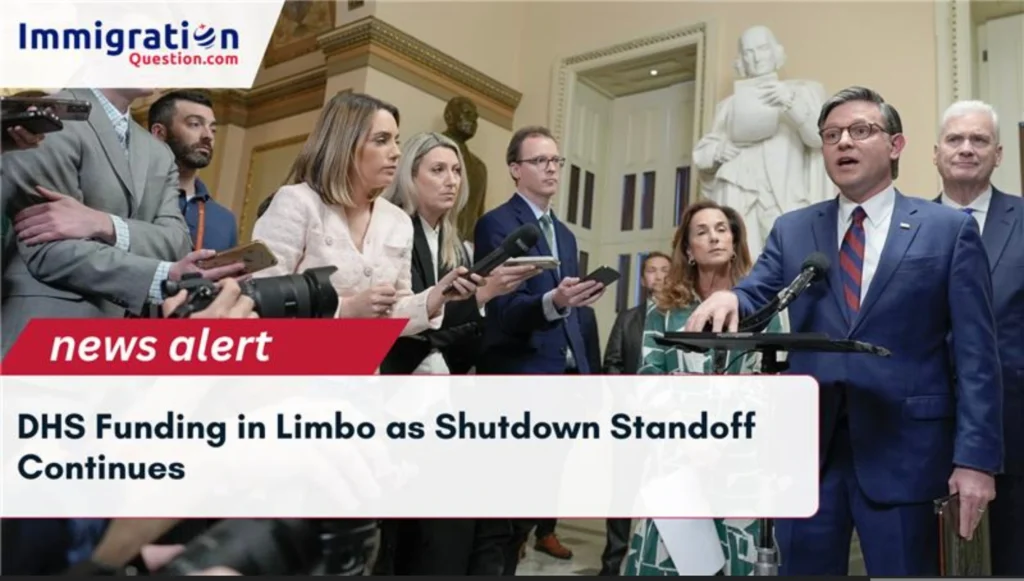
Federal funding for the U.S. Department of Homeland Security remains uncertain as lawmakers struggle to resolve a prolonged political standoff centered on immigration enforcement policy. The partial shutdown, which began in mid-February, has stretched for weeks after Congress failed to pass a long-term funding agreement.
Although the Senate has approved a measure to restore funding for much of the department, the House of Representatives has yet to take any action, leaving the future of DHS operations unclear. The agency, which oversees immigration enforcement, border security, disaster response, and transportation safety, continues to operate under strain, with some employees working without consistent pay and certain services experiencing disruptions.
Congressional Divide Over Immigration Enforcement
At the center of the impasse is a deep disagreement between Republicans and Democrats over immigration enforcement priorities. Republican lawmakers are pushing for increased funding to support expanded deportation efforts, including additional detention capacity and resources for agencies such as Immigration and Customs Enforcement (ICE) and Customs and Border Protection (CBP). Democrats, on the other hand, are advocating for stricter oversight measures, including limits on enforcement tactics and greater accountability for federal immigration officers. These competing priorities have made it difficult to reach a compromise, with both sides resisting proposals that do not fully address their policy concerns.
Temporary Measures and Operational Impact
In response to the funding gap, President Donald Trump has taken interim steps to ensure that DHS employees continue to receive pay while negotiations continue. Despite these measures, the shutdown has had noticeable operational effects, particularly in areas such as airport security and administrative services. While essential functions like immigration enforcement and border operations have largely continued, delays, staffing shortages, and service interruptions have been reported across various DHS components. Experts note that prolonged uncertainty can place additional strain on both personnel and infrastructure, especially as agencies attempt to maintain operations without stable funding.
Uncertain Path Forward
With the House yet to vote on the Senate-backed funding proposal, the path to resolving the shutdown remains unclear. Lawmakers are continuing discussions on whether to pass a short-term funding extension or pursue a broader agreement that addresses immigration enforcement disputes. Analysts suggest that the outcome could have lasting implications for how immigration policy is funded and implemented, particularly as debates over enforcement and oversight intensify. The longer the deadlock continues, the greater the pressure on Congress to reach a resolution that ensures stability for DHS operations and the communities affected by its policies.
For continuous, neutral coverage of immigration policy developments, detention practices, and enforcement issues, visit ImmigrationQuestion.com.
Post your immigration questions for free and get answers from licensed immigration attorneys.
Download the free ImmigrationQuestion.com app on the Google Play Store and the Apple App Store.
Resources
- https://www.reuters.com/legal/government/fate-dhs-funding-uncertain-us-congress-republicans-decide-next-steps-2026-04-02/
- https://www.theguardian.com/us-news/2026/apr/02/dhs-funding-government-shutdown-house-senate
- https://www.cbsnews.com/news/government-shutdown-dhs-funding/
- https://www.csmonitor.com/USA/Politics/2026/0213/congress-dhs-funding-immigration
Disclaimer
**ImmigrationQuestion.com is a networking platform founded by Immigration Attorneys. It serves as a meeting ground for licensed immigration attorneys and people with immigration questions. It is not a law firm. It is not affiliated with or endorsed by USCIS or AILA. Attorneys on this platform are independent and have the discretion to offer a free consultation and/or set their fees under the law.