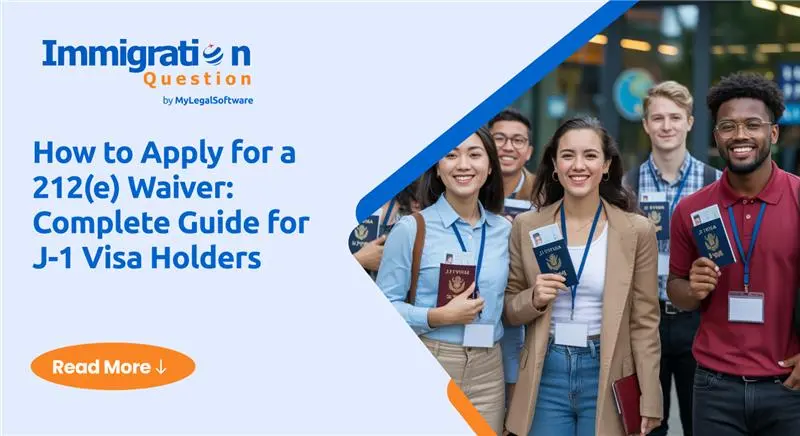
The 212(e) rule applies to certain J-1 visa holders who must return to their home country for two years before applying for specific U.S. immigration benefits.
A 212(e) waiver gives eligible applicants the ability to bypass this requirement. Understanding who is affected, what the rule restricts, and how the waiver process works is essential for long-term immigration planning.
212(e) J-1 Waiver Overview
The 212(e) rule is part of U.S. immigration law and requires some J-1 exchange visitors to spend two years in their home country after completing their program.
It impacts J-1 holders who received government funding, have skills considered important to their home country, or participated in graduate medical training.
A waiver removes this requirement so individuals can pursue immigration benefits such as employment-based visas, family-based petitions, or adjustments of status.
A waiver is necessary when a J-1 participant intends to remain in the United States for work or family reasons that are restricted by the rule.
What Is the 212(e) Rule?
Section 212(e) of the Immigration and Nationality Act states that certain J-1 visa holders must return to their home country for a total of two years before they can apply for specific U.S. immigration benefits.
The requirement begins only after the J-1 program ends. The rule does not require immediate departure and does not prevent someone from holding certain nonimmigrant visas.
Instead, it limits access to benefits such as H-1B status, L-1 status, or permanent residence until the requirement is met or waived.
Who Is Subject to the 212(e) J-1 Requirement?
A J-1 holder may be subject to the two-year requirement if any of the following apply:
- Funding was received from a U.S. government agency
- Funding was provided by the home government
- The field of study or skill appears on the home country Skills List
- The program involved graduate medical education or clinical training
How to Check If You Are Subject to 212(e)
Two documents usually indicate whether the rule applies:
- A note on the DS-2019 form
- An annotation on the J-1 visa stamp
These indicators are not always correct. If there is any doubt, applicants can seek an advisory opinion for clarification.
What 212(e) Prevents You From Doing
If subject to the two-year requirement, a person generally cannot:
- Change status inside the United States to H-1B
- Change status to L-1
- Apply for a green card through adjustment of status
- Obtain H or L visas at a U.S. consulate
These restrictions remain until the requirement is completed or a waiver is approved.
What Is a 212(e) J-1 Waiver?
A 212(e) waiver is an official exemption that removes the two-year home residency obligation. Once approved, the individual may move forward with immigration benefits that were previously restricted.
Waivers are commonly used by J-1 holders with U.S. job offers, those pursuing family-sponsored immigration, and individuals seeking long-term residence or career opportunities.
Types of 212(e) Waivers
No Objection Statement Waiver
This waiver is based on a written statement from the home government indicating that it does not object to the applicant remaining in the United States.
Hardship Waiver
This waiver applies when returning home would cause exceptional hardship to a U.S. citizen or lawful permanent resident spouse or child. Evidence must show hardship beyond normal separation.
Persecution Waiver
This waiver is available when the applicant fears persecution in the home country due to race, religion, political opinion, or similar protected grounds.
Interested Government Agency Waiver
A federal agency may request a waiver if the applicant’s continued presence supports the agency’s work or national interest.
Conrad 30 Waiver (Physicians Only)
This waiver applies to J-1 physicians who agree to serve in medically underserved areas for three years. It supports healthcare needs in shortage regions.
What You Need to Apply for a 212(e) Waiver
Applicants must gather and submit:
- Proof that the 212(e) rule applies
- Online submission of Form DS-3035
- Supporting documents specific to the waiver type
- Application fee
- Form I-612 for hardship or persecution waivers
212(e) Waiver Application Process
Step 1: File Form DS-3035 Online
This form begins the waiver request and generates a case number and barcode needed for processing.
Step 2: Mail the Waiver Application Packet
Applicants must mail:
- DS-3035 barcode sheet
- Copies of DS-2019 forms
- Passport biography page
- Statement of reason for seeking the waiver
Step 3: Submit Waiver-Specific Evidence
Each waiver type requires different evidence. For example:
- No Objection cases require an official letter from the home government
- Hardship cases require detailed documentation of hardship
- Persecution cases require evidence of risk
Step 4: State Department Review
The Waiver Review Division evaluates the case and issues a favorable or unfavorable recommendation.
Step 5: USCIS Decision
USCIS makes the final determination. Approval allows applicants to pursue immigration benefits that were previously restricted.
212(e) Waiver Processing Times
Timelines vary widely depending on the waiver type. No Objection and Interested Government Agency waivers usually process faster.
Hardship and persecution waivers take longer due to the detailed evidence required. Applicants may track their cases and sometimes receive Requests for Evidence. Interviews are rare but possible.
What Happens After Your 212(e) Waiver Is Approved?
Approval includes a favorable recommendation followed by a USCIS approval notice. Applicants may then pursue visas, adjustment of status, or employment-based petitions without the two-year restriction.
Why Legal Support Matters for 212(e) Waiver Applications
Legal professionals can help applicants identify the correct waiver category, prepare evidence, and avoid delays. Attorneys also help with complex hardship claims and government agency sponsorship processes.
Although no result is guaranteed, legal guidance improves the completeness and accuracy of an application. For more immigration guidance and resources, visit ImmigrationQuestion.com.
Key Takeaways
- The 212(e) rule may require certain J-1 holders to return home for two years.
- The rule restricts access to H visas, L visas, and green card applications.
- A waiver removes these limits and allows individuals to continue immigration processes.
- Waiver categories include No Objection, Hardship, Persecution, Interested Government Agency, and Conrad 30.
- The process requires Form DS-3035, supporting evidence, and review by the State Department and USCIS.
- Processing times vary by category and evidence submitted.
Frequently Asked Questions
- Can I apply for a 212(e) waiver while still on my J-1 visa?
Yes. Many individuals apply during their J-1 program to avoid future delays. - Do all J-1 visa holders need a 212(e) waiver?
No. Only those subject to the home residency requirement need a waiver. - What happens if my 212(e) waiver is denied?
You may complete the two-year requirement, reapply with stronger evidence, or consider another eligibility category. - Can I travel while my 212(e) waiver is pending?
Yes, but travel may be risky if your J-1 visa expires while the waiver is under review. - Can I change status without a 212(e) waiver?
Generally no. Most status changes and green card applications require either completing the two-year rule or obtaining a waiver. - How long does a 212(e) waiver take?
Processing ranges from a few months to more than six months depending on the waiver type.